
The 1% Risk Rule: How Much Should You Risk Per Trade?
By RiskQuo Team · · Updated · 6 min read
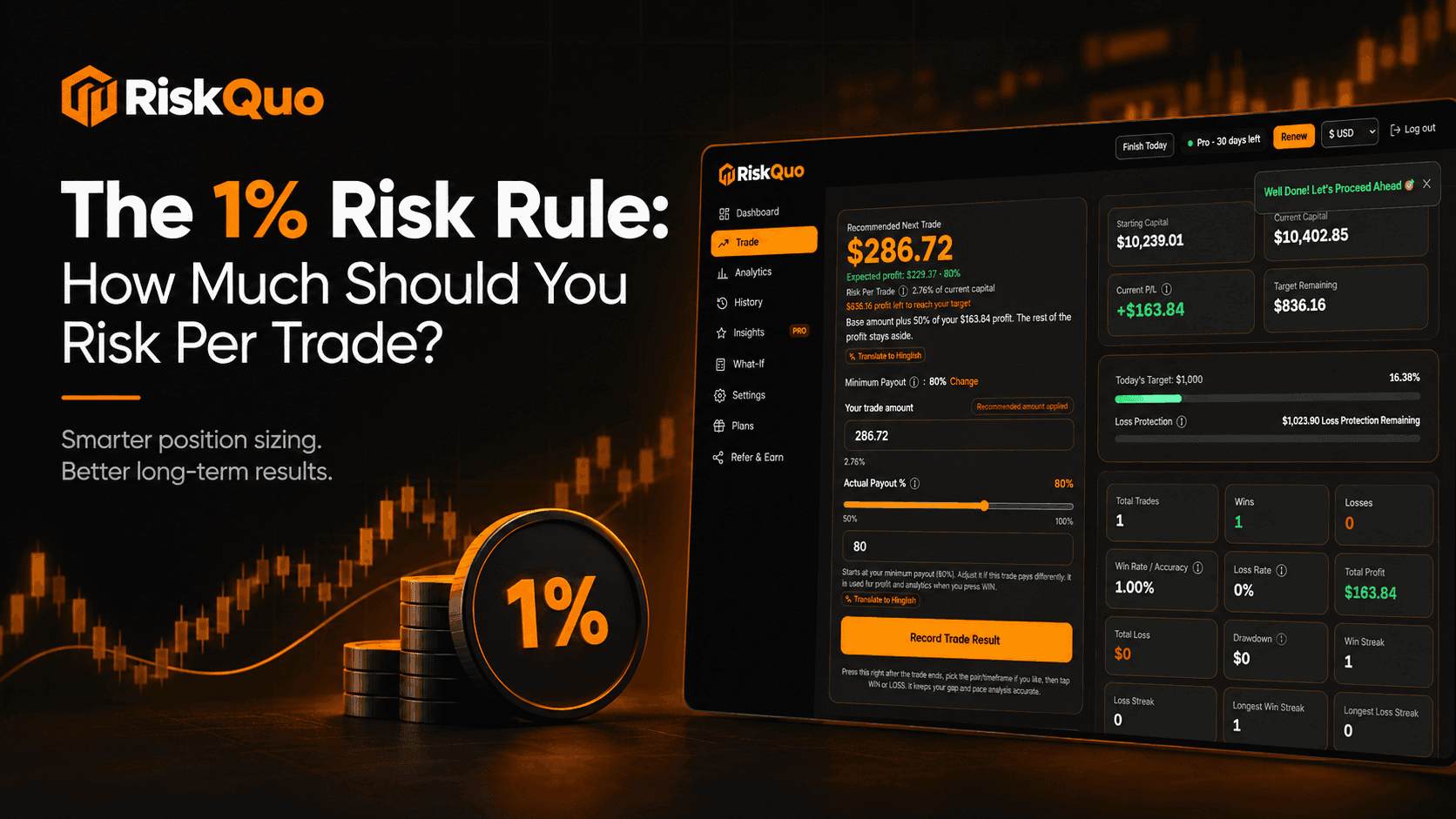
"How much should I put on this trade?" is the most important question in trading, and most beginners answer it with a feeling. The 1% risk rule replaces the feeling with a number: never risk more than 1% of your account on a single trade. Many traders allow up to 2%. This guide explains why the rule works, shows it with three real account sizes, and explains how to use it every day.
What "risk per trade" means
Risk is the money you lose if the trade goes wrong — not the money you hope to make.
- In binary options, the risk is the whole trade amount, because a losing trade loses everything you placed.
- In forex, stocks and crypto, the risk is the money you lose if your stop-loss is hit. The trade itself can be much bigger than the risk.
The 1% rule limits that risk, so every single loss is small compared with your account.
The rule with three real accounts
| Account | 1% per trade | 2% per trade | Profit on a win at 80% payout (1%) |
|---|---|---|---|
| ₹5,000 | ₹50 | ₹100 | ₹40 |
| ₹20,000 | ₹200 | ₹400 | ₹160 |
| $100 | $1 | $2 | $0.80 |
Example 1: a ₹5,000 account
Priya has ₹5,000. At 1%, each binary trade is ₹50. A win at an 80% payout adds ₹40; a loss removes ₹50. Her daily loss limit is 10% = ₹500, so she stops after 10 losing trades — although most days she will stop far earlier because of her daily target. If she prefers 2%, each trade is ₹100 and the same ₹500 limit arrives after 5 losses.
Example 2: a ₹20,000 account
Arjun has ₹20,000. At 1% each trade is ₹200, at 2% it is ₹400. It is tempting to think "₹200 is too small for my account", but a string of ₹2,000 trades (10%) would put the account at serious risk after just a few losses. The size of the account does not change the maths of a losing streak.
Example 3: a $100 account
With $100, 1% is exactly $1, which is also the minimum trade on many platforms. That is fine. But if the minimum were $5, one trade would already be 5% of the account. With very small accounts the honest answer is: trade the minimum, keep a strict daily loss limit, and grow slowly — do not raise the risk to "make it worth it".
Why 1%? What a losing streak really costs
Every trader has losing streaks, even good ones. The question is only how much a streak costs you. Here is a ₹5,000 account after 10 losses in a row, when each trade is a percentage of the current balance:
| Risk per trade | Balance after 10 losses | Lost | Gain needed to get back |
|---|---|---|---|
| 1% | ₹4,521.91 | 9.6% | +10.6% |
| 2% | ₹4,085.36 | 18.3% | +22.4% |
| 5% | ₹2,993.68 | 40.1% | +67% |
| 10% | ₹1,743.39 | 65.1% | +187% |
At 1%, a terrible streak costs under 10% and needs about an 11% gain to recover. At 10%, the same streak takes two-thirds of the account, and you would need to almost triple what is left just to get back to the start. Losses and gains are not symmetric: the deeper you fall, the harder the climb. The 1% rule keeps you near the top of the hill.
Fixed amount or percentage of the current balance?
Both are fine for beginners. A fixed ₹50 on a ₹5,000 account loses ₹500 over 10 losses (₹4,500 left). Recalculating 1% of the current balance each time leaves ₹4,521.91 — slightly better, because trades shrink as the balance falls. A simple middle way: calculate 1% of your balance once each morning and use that amount all day.
Using the rule in binary options, step by step
- Check your balance at the start of the day.
- Multiply by 1% (or 2%). That is your trade amount for today.
- Write down your daily loss limit (for example 10%) and your daily target.
- Use the same amount for every trade. Never raise it after a loss.
- Stop when you reach the loss limit or the target.
Do not forget the payout. At 80%, you need to win about 55.6% of your trades just to break even — see break-even win rate. The binary risk calculator shows the risk and result of any trade, and the money management plan builds your trade size, loss limit and break-even rate in one place.
Using the rule in forex and stocks
Here the position size depends on the stop-loss:
- Stocks or crypto: ₹20,000 account, 1% = ₹200. You buy at ₹500 with a stop at ₹490, so you risk ₹10 per share. Position = ₹200 ÷ ₹10 = 20 shares.
- Forex: $10,000 account, 1% = $100, stop-loss 20 pips, about $10 per pip per standard lot. Lots = 100 ÷ (20 × 10) = 0.5 lots.
A wider stop means a smaller position, a tighter stop a bigger one, but the money at risk stays the same. The position size calculator does this in seconds.
Common objections
"My account is small, 1% is too little."
A small account is exactly when you cannot afford big losses. Trading 20% of a small balance does not grow it faster; it empties it faster.
"I am very sure about this trade."
Confidence changes how much you lose when you are wrong, not the odds of being right. Keep the size fixed and let good decisions show up in your win rate over time.
"I will make it back on the next trade."
This thought leads to raising the amount after a loss — martingale. It is the fastest way to turn a normal streak into a lost account. Read why martingale blows accounts.
1% or 2%?
Both are reasonable. 1% is safer and gives you more room to learn. 2% grows faster, but a losing streak hurts twice as much. Start at 1%, record every trade, and move to 2% only after a few months of results clearly above your break-even win rate. If results drop, go back to 1%.
Summary
- Risk 1% (at most 2%) of your current balance on any single trade.
- ₹5,000 → ₹50, ₹20,000 → ₹200, $100 → $1 per trade at 1%.
- At 1%, ten losses cost under 10%; at 10%, they cost about two-thirds of the account.
- Never raise the amount to win back a loss, and stop at a daily loss limit.
Risk disclaimer: trading involves a high risk of loss. This article is education, not financial advice. No rule or tool guarantees profit.
Try the calculator
Check the numbers from this article with your own balance. Free, no login.
Frequently asked questions
What is the 1% risk rule?
Never risk more than 1% of your account on a single trade. Some traders allow up to 2%.
How much is 1% of a ₹5,000 account?
₹50 per trade. At 2% it is ₹100.
What if 1% is below the minimum trade size?
Then trade the platform minimum, but understand that you are risking more than 1%. With a very small account, grow it slowly or add money you can afford before trading bigger.
Is 1% too small to make money?
It is slower, not smaller in the long run. The rule protects you from losing streaks, which is what destroys most accounts.
In forex, is the 1% the trade size?
No. In forex and stocks, 1% is the money you lose if your stop-loss is hit. The position itself can be larger. Use a position size calculator.
Should the 1% be of my starting balance or current balance?
Of your current balance, recalculated once a day. Trades then get smaller after losses and bigger after gains.
Related posts
Risk Management · 24 September 2026 · 6 min read
Break-Even Win Rate: How Payout % Decides If You Can Ever Profit
At an 80% payout you must win 55.6% of trades just to break even. The formula, a full table for 70–92% payouts and what it means for you.

Beginner Guides · 23 September 2026 · 6 min read
Quotex Money Management Guide for Beginners
A simple Quotex money management plan: stake size, daily loss limit, number of trades and clear stop rules, with a $100 worked example.
Trading involves high risk. This article is education, not financial advice. RiskQuo gives no signals and is not affiliated with any trading platform or broker. Read the full disclaimer.