
Break-Even Win Rate: How Payout % Decides If You Can Ever Profit
By RiskQuo Team · · Updated · 6 min read
Many traders say "I win more than I lose" and still watch their balance fall. The reason is the payout. In binary options a losing trade costs the full amount, but a winning trade pays only a percentage of it. That means you must win more than half of your trades just to stay at zero. This number is your break-even win rate, and it decides whether profit is possible at all.
The formula
If the payout is p (as a decimal, so 80% = 0.80), then:
Break-even win rate = 1 ÷ (1 + p)
Why? Imagine 100 trades of ₹100 each. With a win rate w, you win 100w trades and earn ₹100 × p on each, and you lose 100(1 − w) trades at ₹100 each. You break even when the two are equal: w × p = (1 − w), which gives w = 1 ÷ (1 + p).
Example: at an 80% payout, 1 ÷ 1.80 = 0.5556, so you need 55.6% winning trades just to break even.
Break-even table for 70%–92% payouts
| Payout | Break-even win rate | Wins needed out of 100 trades |
|---|---|---|
| 70% | 58.82% | 59 |
| 72% | 58.14% | 59 |
| 75% | 57.14% | 58 |
| 77% | 56.50% | 57 |
| 78% | 56.18% | 57 |
| 80% | 55.56% | 56 |
| 82% | 54.95% | 55 |
| 85% | 54.05% | 55 |
| 87% | 53.48% | 54 |
| 88% | 53.19% | 54 |
| 90% | 52.63% | 53 |
| 92% | 52.08% | 53 |
The last column rounds up: to be above break-even over 100 trades you need at least that many wins.
Worked examples with real numbers
All examples use 100 trades of ₹100 each.
| Your win rate | Result at 80% payout | Result at 85% payout |
|---|---|---|
| 55% | −₹100 | +₹175 |
| 56% | +₹80 | +₹360 |
| 58% | +₹440 | +₹730 |
| 60% | +₹800 | +₹1,100 |
How to read the first row at 80% payout: 55 wins × ₹80 = ₹4,400 profit, and 45 losses × ₹100 = ₹4,500 lost, so the result is −₹100. The trader won more than half the trades and still lost money.
Now compare the columns. With a 56% win rate, the same trader makes +₹80 at an 80% payout but +₹360 at an 85% payout — about 4.5 times more, only because of a 5-point higher payout. The payout is not a small detail. It can decide everything.
What this means for you
1. Know your real win rate
Your feeling about your win rate is usually too high. Record every trade for at least a few weeks and calculate wins ÷ total. Compare it with the break-even rate for the payout you usually trade.
2. Prefer higher payouts
If two assets look equally good, the one with the higher payout needs a lower win rate. Trading low-payout assets quietly raises the bar you have to clear.
3. Trade size does not fix a low win rate
If you are below break-even, bigger trades only make you lose faster. Smaller trades lose slower and give you time to improve. Trade size controls speed, not direction.
4. Martingale does not change the maths
Raising the stake after losses does not change your win rate. It only moves the losses into rare, huge streaks. See why martingale blows accounts.
Why payouts change — and why it matters
On most binary platforms the payout is not fixed. It can differ between assets, between regular and OTC markets, and during the day, for example when a market is very busy or very quiet. A pair that pays 88% in the morning might pay 78% later. On the table above that moves your break-even rate from 53.2% to 56.2% — a full 3 points higher, without anything else changing.
So make checking the payout part of every trade, not something you look at once. If the payout drops below the level your win rate can support, skip the trade or choose another asset. Skipping a trade is also a trading decision, and often the best one.
Expected value per trade
The average result of one trade is: win rate × profit on a win − loss rate × stake. With a ₹100 stake, 85% payout and a 60% win rate: 0.60 × ₹85 − 0.40 × ₹100 = ₹51 − ₹40 = +₹11 per trade. With a 52% win rate: 0.52 × ₹85 − 0.48 × ₹100 = ₹44.20 − ₹48 = −₹3.80 per trade. Over hundreds of trades, that small number is what your balance follows.
How to measure your real win rate (and not fool yourself)
Take your trade records and count only trades that actually closed: wins and losses. Divide wins by the total. Example: 40 trades, 23 wins → 23 ÷ 40 = 57.5%. At an 80% payout that is above the 55.6% break-even rate — good news, but not proof yet.
Small samples are noisy. With only 40 trades, a trader whose true win rate is 55% can easily score 60% or 50% just by luck: one or two trades more or less change the result by 2.5 points each. Before you trust your number, collect at least 100 trades, and ideally a few hundred. Then compare again with the table above.
Also watch for these common self-deceptions:
- Forgetting the bad days. If you only write down trades on good days, your win rate will look far better than it is.
- Counting "almost wins". A trade that was right "until the last second" is still a loss.
- Mixing payouts. If you trade assets with different payouts, compare each group with its own break-even rate.
- Changing the stake. A 60% win rate with small trades and a 40% win rate on your biggest trades can still lose money overall. Keep the stake fixed so the win rate tells the truth.
Using the break-even rate in your plan
- Find the payout you trade most often and look up its break-even rate.
- Keep your stake at 1–2% of your balance (see the 1% risk rule).
- Record every trade and compare your real win rate with the break-even rate each week.
- If you are below it, reduce size and practise; if you are clearly above it, keep your plan and let it compound slowly (see compounding plan).
The money management plan calculator shows your break-even win rate together with your stake, loss limit and target.
Summary
- Break-even win rate = 1 ÷ (1 + payout). At 80% it is 55.6%, at 85% it is 54.1%, at 70% it is 58.8%.
- Winning more than half your trades is not enough if the payout is low.
- A few points of payout can multiply your result.
- Trade size changes speed, not direction. Only your win rate and payout decide direction.
Risk disclaimer: trading involves a high risk of loss. The examples show maths, not promised results. This article is education, not financial advice.
Try the calculator
Check the numbers from this article with your own balance. Free, no login.
Frequently asked questions
What is the break-even win rate?
The percentage of trades you must win to end at zero over time. Below it you lose money, above it you make money.
What is the formula?
Break-even win rate = 1 ÷ (1 + payout), with the payout as a decimal. At 80% payout: 1 ÷ 1.8 = 55.6%.
Why is it above 50%?
Because a losing trade costs 100% of the amount while a winning trade pays less than 100%.
Does trade size change the break-even win rate?
No. Trade size changes how fast you win or lose money, not the win rate you need.
How do I know my real win rate?
Record every trade for a few weeks. Count wins ÷ total trades. Feelings are not reliable; records are.
What if my win rate is below break-even?
Trade the smallest size or practise on a demo account, and look for higher-payout assets. Do not trade bigger to catch up.
Related posts

Strategies · 22 September 2026 · 6 min read
How to Make a Compounding Plan for Binary Trading
A realistic binary compounding plan: trade size from your balance, a small daily target and a loss limit. Plus why 10%-a-day plans fail.

Risk Management · 21 September 2026 · 6 min read
The 1% Risk Rule: How Much Should You Risk Per Trade?
How much to put on one trade? The 1% rule explained with ₹5,000, ₹20,000 and $100 accounts, plus what a losing streak does at 1%, 2%, 5% and 10%.
Strategies · 20 September 2026 · 6 min read
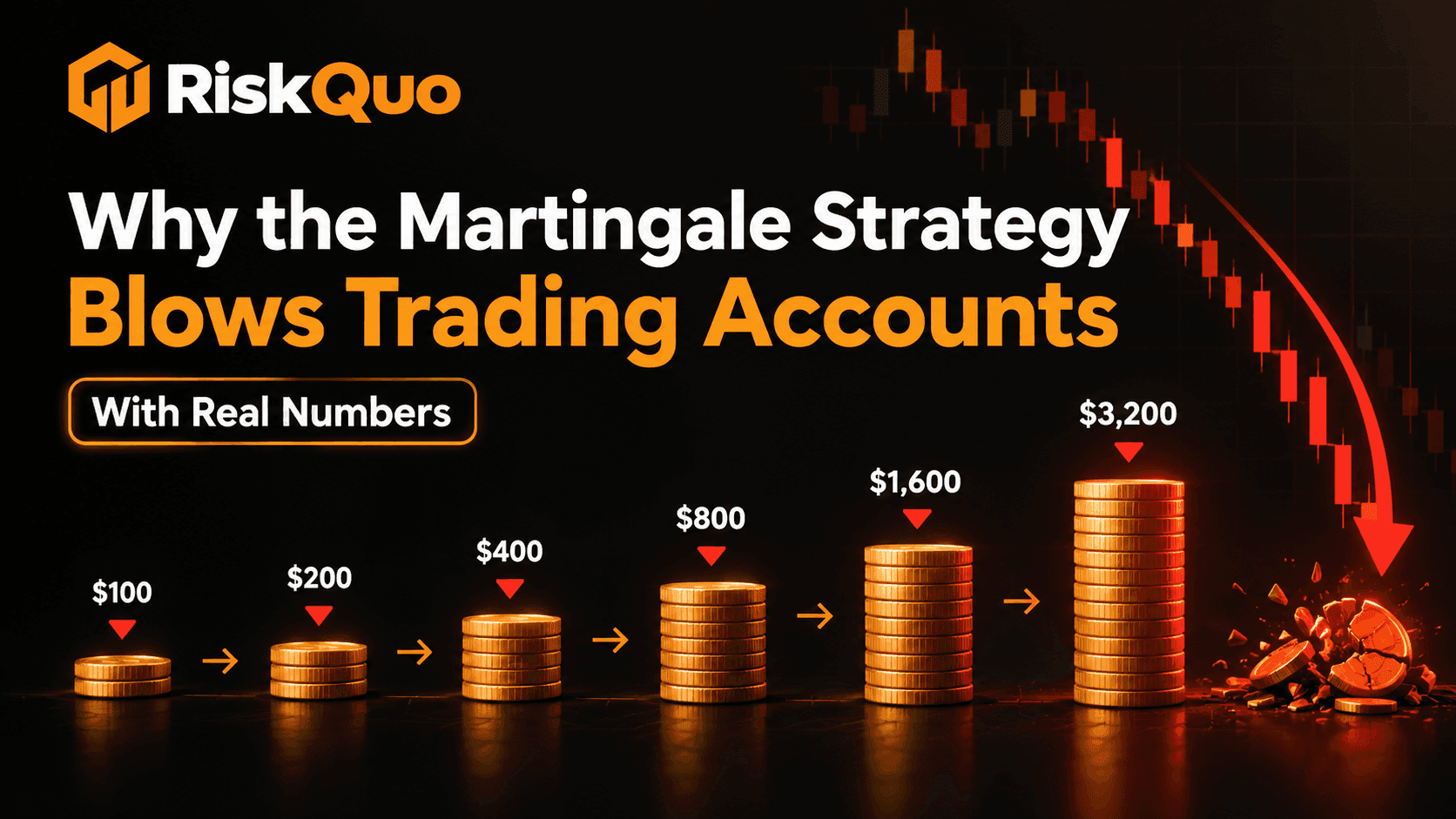
Why the Martingale Strategy Blows Trading Accounts (With Real Numbers)
Martingale wins small amounts often and then loses almost everything in one normal losing streak. See the real stake table for 5 to 8 losses.
Trading involves high risk. This article is education, not financial advice. RiskQuo gives no signals and is not affiliated with any trading platform or broker. Read the full disclaimer.